
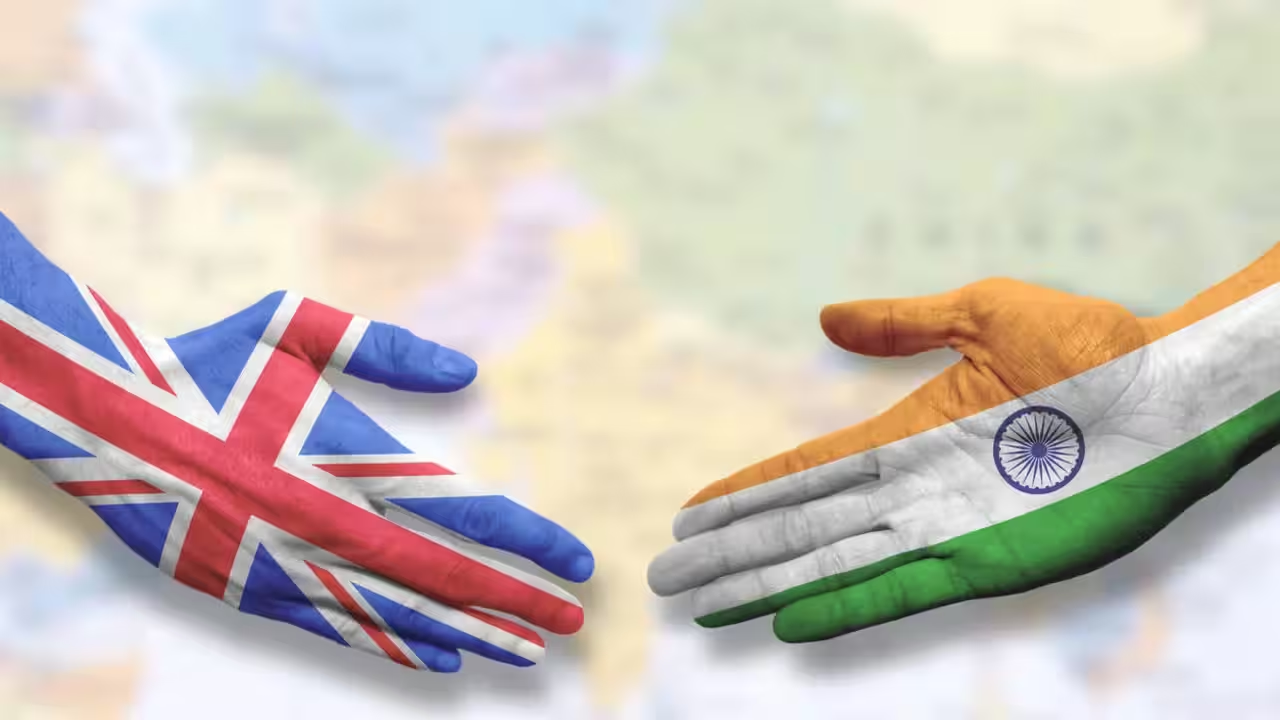
The India-UK Comprehensive Economic and Trade Agreement (CETA) came into force today, 15 July 2026, along with its companion pact, the Double Contribution Agreement (DCA), a social security agreement.Commerce Secretary Rajesh Agrawal called it a “gold standard” deal spanning 30 chapters that goes well beyond tariff cuts. The agreement was signed last year in London on July 24, by the Minister for Trade and Industry, Piyush Goyal, and the Secretary of State for Enterprise and Trade of the United Kingdom, Jonathan Reynolds, in the presence of the Prime Minister. Narendra Modi and then UK Prime Minister Keir Starmer, after 14 rounds of negotiations starting in 2022.The government has repeatedly described it as a “people-centred” pact, with farmers, fishermen and MSMEs positioned as its main beneficiaries, making it a high-priority topical issue.
The concept in simple terms
- A Free Trade Agreement (FTA) is an agreement between two or more countries to reduce or eliminate tariffs and other trade barriers on goods and often services traded between them.
- CETA is a deeper version of an FTA. In addition to tariffs, it covers services, digital trade, government procurement, intellectual property, investment, labour, environment and gender, coming closer to what is usually called CEPA (Comprehensive Economic Partnership Agreement).
- Under WTO rules, countries must normally treat all trading partners equally (most-favoured-nation or MFN principle). FTAs are a permitted exception to this rule under Article XXIV of the GATT, which allows for preferential treatment between signatories.
- The India-UK CETA is India’s most ambitious trade agreement with a developed economy to date, both in terms of the scale of market opening and the range of issues it covers.
how it works
The UK will immediately remove duties on 99% of Indian tariff lines, covering approximately 97.7% of trade value. This removes tariffs of up to 70% on processed food, 21.5% on marine products, 18% on engineering products and auto components, 16% on leather and footwear, 12% on textiles and clothing and 8% on chemicals and pharmaceuticals.India, in turn, has opened 89.5% of its tariff lines, covering 91% of the UK’s export value, although only 24.5% of this value has immediate duty-free access. The rest is done in phases over 5, 7 or 10 years, especially for sectors under Make in India or the Production Linked Incentive Scheme.In particular, India cut tariffs on cars from over 100% to 10% under an import quota, and duties on Scotch whiskey and gin from 150% to 75% on day one, reducing to 40% in year 10 within an annual quota of 2 million litres.Both sides have kept sensitive sectors out of the concessions. India has excluded dairy products, cereals, millets, pulses, edible oils, apples, various vegetables, gold, jewellery, laboratory diamonds, smartphones, optical fiber and marine vessels.A simplified Rules of Origin mechanism allows self-certification of origin by exporters and authorized economic operators achieve faster customs clearance.Non-tariff barriers are addressed through chapters on sanitary and phytosanitary standards (SPS) and technical barriers to trade (TBT), aimed at preventing quality or safety standards from becoming disguised trade restrictions.Implementation is overseen by a joint commission with sectoral sub-committees and working groups covering rules of origin, mobility, IP, recruitment and gender. Any changes need mutual consent and take effect 60 days after both parties confirm national approval.
Governing bodies and agreements
- Ministry of Trade and Industry (Department of Trade): the nodal ministry that negotiated CETA.
- General Directorate of Foreign Trade (DGFT): implements tariff programs and certification of origin on the Indian side.
- Double Contribution Convention (DCC): the linked social security pact, signed on 10 February 2026, which exempts Indian professionals on temporary assignments in the UK from dual social security contributions for up to five years, benefiting over 75,000 professionals from over 900 companies.
- India-UK Joint Committee: the governing body created under CETA to oversee implementation.
- Article XXIV of the GATT (WTO): the legal basis that allows FTAs as an exception to the MFN principle.
- India-UK Vision 2035: a broader strategic roadmap accompanying CETA, covering defense, climate and education cooperation, building on the 2021 Comprehensive Strategic Partnership.
Relevance to India
- farmers: Duty free access is opened for turmeric, pepper, cardamom and processed items like mango pulp, pickles and pulses. Around 97.1% of processed food tariff lines have immediate duty-free entry into a UK agricultural import market valued at over $63 billion. Sensitive commodities such as dairy, cereals, millet, edible oils and apples remain protected to protect rural incomes.
- Fishermen: The removal of tariffs of up to 21.5% on marine products is expected to help seafood exporters in Kerala, Andhra Pradesh, Gujarat, Tamil Nadu and Odisha.
- MSMEs: Labour-intensive sectors such as textiles (previously facing 12% UK duty) and leather and footwear (up to 16%) move to zero duty, putting Indian exporters on par with competitors such as Bangladesh and Vietnam. Self-certification of origin cuts down on paperwork and the government has promised training and support on the digital platform to help small exporters navigate the UK’s rules of origin and certification requirements.
- Services and mobility: A dedicated annual quota of 1,800 spaces for Indian chefs, yoga instructors and classical musicians, along with easier movement for business and professional visitors, supports smaller service providers alongside large IT and financial firms.
- Challenges: Trade analysts have pointed out that India’s MSMEs may still struggle with the UK’s strict SPS and technical compliance rules, even when tariffs are zero. There are also concerns that easier access to UK agriculture, if extended in future rounds, could put pressure on specific rural segments despite current exclusions.
- Scale: Bilateral trade in goods stood at about $25 billion in FY26, with total trade close to $56 billion; both countries aim to double this by 2030.
Preliminary data box
Main practice questions
“India-UK CETA has been described as a people-centred trade deal”. Critically examine its likely impact on Indian agriculture and the MSME sector, highlighting both the opportunities created and the challenges that remain.
Five key terms to remember
- CETA (Comprehensive Economic and Commercial Agreement): A deep FTA covering goods, services, investment and regulatory cooperation, not just tariffs.
- Most Favored Nation (MFN): The principle of the WTO requires equal trade treatment for all partners, with FTAs as a permitted exception.
- Rules of origin: Criteria used to determine the “economic nationality” of a traded product, to decide whether it is eligible for preferential tariff treatment.
- Double Contribution Agreement (DCC): A social security pact that prevents workers from paying social security twice, both in their home and host countries.
- Sensitive/Exclusion List: Products that a country keeps out of tariff concessions in a trade agreement to protect domestic producers.
Frequently asked questionsQ: What is the difference between an FTA and a CEPA?An FTA usually focuses on reducing tariffs on goods. A CEPA (or CETA, as in this case) is broader and also includes services, investment, IP and regulatory cooperation.Q: Do free trade agreements violate WTO rules?GATT Article XXIV does not specifically allow FTAs and customs unions as exceptions to the MFN principle, provided they meet certain conditions on coverage and transition periods.Q: Is India-UK CETA India’s first major trade pact with a developed Western economy?It is among India’s most comprehensive such agreements, following earlier agreements such as the India-UAE EPA and the India-Australia ECTA, but is the first FTA of this depth with a G7 economy.Q: What are rules of origin and why are they important for MSMEs?They determine whether a product is genuinely originating in the exporting country and therefore qualifies for preferential tariffs. Compliance with documentation and certification standards can be a compliance burden for smaller exporters.