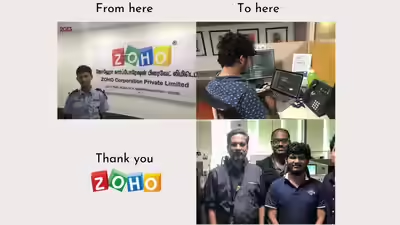
For millions of Indian students, the dream is simple: score well in class 12, take an entrance exam, get a B.Tech degree and land a software job. Abdul Alim’s journey took a completely different route. He never went to college. He studied only up to Class 10. However, today, after more than a decade at Zoho Corporation, he is a member of the technical staff, proof that skills, curiosity and the right mentor can sometimes open doors that degrees cannot.In India, conversations about careers often revolve around engineering schools, entrance exams and campus placements. Every year, thousands of students spend months preparing for JEE, hoping that an engineering degree will lead them to a software job.But every now and then, a story comes along that reminds us that there is more than one path to success.Abdul Alim’s journey is one such story.He is currently a member of the technical staff at Zoho Corporation, where he has been for over 12 years. However, when he first joined the company in 2013, he didn’t carry a laptop or join as an engineer.He was guarding the entrance.He left home with only Rs 1,000After completing class 10, Alim decided to leave home in search of work.According to LinkedIn post in which he shared his story, he had only Rs 1,000 with him. Almost Rs 800 went towards a train ticket. The remaining money quickly disappeared and for almost two months he struggled before finding work as a security guard at Zoho.For many, getting a steady job would have been the end of the journey.For Alim, it became the beginning.
One conversation changed everything
While working long security shifts, Alim caught the eye of a senior employee named Shibu Alexis.Instead of simply greeting him in passing, the employee asked him about his education and if he knew anything about computers.Alim mentioned that he had learned some HTML during school.That brief conversation changed the course of his life.The senior employee offered to teach him programming.
Learning after a 12 hour shift
The arrangement was not at all easy.After completing a 12-hour security assignment each day, Alim stayed behind to learn programming.There was no engineering classroom, no training institute, and no formal degree program.Instead, there was curiosity, consistency, and a mentor willing to invest time in someone who wanted to learn.Months of practice gradually turned into confidence.About eight months later, Alim built a small app that accepted user input and displayed it visually.It wasn’t a great commercial product.But it demonstrated something far more important: its ability to learn.
The interview he never thought he’d get
Impressed by the application, the senior employee showed it to his manager and asked if Alim could be interviewed for a technical role.Alim later admitted that he never imagined such an opportunity would come his way.I hadn’t gone to college.He had no engineering degree.Like many young people, he believed that this would only prevent him from becoming a software engineer.Instead, they told him something he still remembers:“At Zoho, you don’t need a college degree. What matters is you and your skills.”He appeared in the interview.He cleaned it up.And his career changed forever.
From security desktop to software development
In 2014, Alim joined Zoho’s technical team as an engineer in training.Over the years, he continued to learn, grow and contribute to product development.He is currently a member of the technical staff and has spent more than a decade building software at the same company where he previously worked as a security guard.His journey also reflects Zoho’s long-standing emphasis on skills-based hiring through initiatives like Zoho Schools of Learning, which focus on practical ability rather than academic credentials.
Classes for students
Alim’s story is not an argument against formal education. For many careers, college remains essential.But it does highlight an important reality of today’s tech industry: practical skills, continuous learning and problem-solving skills are increasingly valued alongside academic qualifications.For students, especially those who may feel discouraged by mishaps in board exams or competitive entrance exams, their journey offers a different perspective.A single exam does not define an entire career.Learning can start anywhere.Sometimes it starts in a classroom.Sometimes it starts after a 12-hour shift at a security desk.And sometimes, all it takes is someone who sees potential before you do.Disclaimer: This article is based on information shared by the individual on LinkedIn, publicly available professional profiles, and other publicly accessible sources. Personal experiences and statements are presented as shared by the individual and have not been independently verified by The Times of India.