
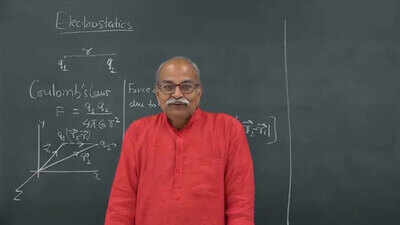
For generations of Indian students, cracking JEE or NEET has often started with two words printed on the cover of a book: Concepts of Physics.Long before online conferencing, training apps, and AI-powered study tools became commonplace, students across the country relied on HC Verma’s books for understanding mechanics, electricity, optics and modern physics. For many aspiring engineers and doctors, solving all the problems in the two famous volumes became almost a rite of passage.But very few know the story behind the man who wrote them.Dr. Harish Chandra Verma, affectionately known as HC Verma or simply HCV, did not set out to write India’s most famous physics textbook. He wrote it because he realized that one of the best physics books in the world was simply not written for Indian students.
A brilliant American textbook inspired him, but also exposed a problem
Born on April 3, 1952 in Darbhanga, Bihar, Harish Chandra Verma grew up in a family where education was highly valued. His father was a school teacher, and Verma developed an early fascination with science.After completing his B.Sc. from Patna Science College, earned his M.Sc. and Ph.D. in Physics from IIT Kanpur.In 1980, he returned to Patna Science College as a professor. Every day, he taught undergraduate students using the internationally acclaimed Resnick and Halliday physics textbook.He admired the book for its scientific depth and clarity. However, something kept bothering him.Many bright students struggled to connect with the examples, language and style of explanation. The textbook assumed a classroom environment and life experiences very different from those of students from small towns and villages in India.Intelligence wasn’t the problem.The problem was communication.
He did not translate the book. He built one from scratch.
Instead of complaining about the lack of a suitable textbook, Verma decided to create one himself.Years of classroom teaching helped him understand exactly where Indian students got confused, what misconceptions they carried, and how concepts could be explained more naturally.The result was Concepts of Physics, first published in 1992.Unlike many textbooks that focus heavily on formulas, HC Verma encouraged students to ask why before learning how.Simple language. Real life examples. Carefully designed illustrations. Thought provoking questions. And numerical problems that test understanding rather than memorization. The formula worked.Within a few years, the book became one of the most recommended physics texts for JEE aspirants. Eventually, it also became a favorite among NEET aspirants, Olympiads and undergraduate engineering students.Today, countless coaching institutes in India still recommend it as one of the best books for creating conceptual clarity.
From Patna to IIT Kanpur
In 1994, Verma joined IIT Kanpur as a faculty member, where he spent more than two decades teaching and conducting research in experimental nuclear physics.In parallel to teaching, he published 139 research papers, contributing significantly to his field.But even as a professor at one of India’s premier engineering institutions, he never lost sight of his first passion: making physics easier for ordinary students.Many of his lectures, demonstrations and classroom sessions continue to be available for free online, helping students far beyond IIT Kanpur.
Making physics affordable and enjoyable
HC Verma believed that science should not depend on expensive laboratory equipment.To make physics accessible to every classroom, he developed more than 600 low-cost physics experiments using everyday materials that teachers could easily replicate.In 2011, he helped establish the National Anveshika Network of India (NANI) under the Indian Association of Physics Teachers (IAPT).The initiative encourages hands-on science learning and now supports learning centers across the country, helping teachers make physics more interactive and enjoyable.
Education beyond the classroom
Even after retiring from IIT Kanpur in 2017, Verma chose not to shy away from education.Instead, he devoted more time to Shiksha Sopan, an educational initiative he co-founded near the IIT Kanpur campus.The organization supports children from economically weaker families by providing academic assistance, mentoring and learning opportunities. Over the years, it has benefited hundreds of students and families.His belief has always been simple: quality education should reach those who need it most.
A Padma Shri and the gratitude of millions
In 2021, the Government of India honored Harish Chandra Verma with the Padma Shrirecognizing his immense contribution to physical education.But perhaps his greatest reward cannot be measured by medals or honors.Every year, thousands of students preparing for JEE, NEET and other exams continue to learn physics through the books he wrote more than three decades ago.For many, “HCV” is not just the name of an author.It represents the moment when difficult physics problems finally started to make sense.And this may be his greatest legacy: that he didn’t just teach equations; he taught generations of students how to think.Disclaimer: This article is based on publicly available information about the life, academic career, published works, interviews and official recognitions of Dr. Harish Chandra Verma. It is intended for educational and inspirational purposes.