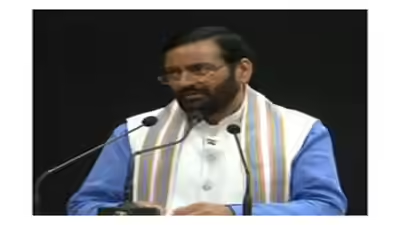
Chandigarh: Haryana Chief Minister Nayab Singh Saini has said that the government aims to establish the state as a world-class knowledge economy hub. To achieve this goal, the educational ecosystem of the State is being remodeled on the principles of ‘Redesign, Reimagine and Reinvest’. Under this vision, comprehensive reforms have been implemented in line with the National Education Policy (NEP) in state universities and their affiliated colleges. The Chief Minister was addressing a function at Guru Jambheshwar University of Science and Technology (GJUST), Hisar on Sunday. He inaugurated and laid the foundation stone of projects worth Rs 7.58 crore. These included the foundation stone of a girls’ hostel to be built at a cost of Rs 6 crore, the inauguration of the Nursing Department building constructed at a cost of Rs 1.40 crore to strengthen health services and medical education, and the inauguration of the Khejarli Mahabalidan Smriti Shilp and Mata Amrita Devi Circle constructed at a cost of Rs. He also announced that the nursing block would be named after Chaudhary Bhajan Lal, according to a statement. The Chief Minister said that under the leadership of Prime Minister Narendra Modi, the National Education Policy has been implemented across the country with a vision to make India a global knowledge superpower. He said that Guru Jambheshwar University has set an exemplary benchmark in effective implementation of NEP and the Government of Haryana has received the Award for Excellence in Implementation of NEP 2025 (Gold Category). He described it as a matter of pride and honor. He said that young people have high expectations from institutions like this university. These institutions should emerge as centers of research and innovation, serving as a bridge between local industries and global technologies. Only then the vision of Viksit Bharat-2047 envisioned by Prime Minister Sh. Narendra Modi will come true. He also urged people to take forward the Prime Minister’s ‘Ek Ped Maa Ke Naam’ campaign, saying that the path shown by Mata Amrita Devi and Guru Jambheshwar Maharaj would help fulfill the dreams of our forefathers towards environmental conservation. The Chief Minister said that in line with the teachings of Guru Jambheshwar Maharaj, the state government strongly believes that the purpose of higher education is not only to award degrees but to build an ethical, sensitive and aware society, which is technologically competent while remaining deeply rooted in its culture and committed to environmental conservation. Referring to Guru Jambheshwar Maharaj and the Bishnoi community, the Chief Minister said that nature occupies a central place in Indian culture, a philosophy that Guru Jambheshwar Maharaj reflected through his life and teachings. In line with these teachings, the two-engine government is taking Haryana to new levels of development while maintaining harmony with nature. He said that the essence of Indian civilization has always been an intimate relationship with nature. In this great tradition, Guru Jambheshwar Maharaj started an environmental movement in the 15th century in the desert region, a vision that was centuries ahead of its time. At a time when much of the world considered nature only as a resource, Guru Jambheshwar Maharaj declared that it was the basis of life, an integral part of dharma and the highest means of public welfare. Saini said that the 29 principles propounded by Guru Jambheshwar Maharaj are not just the discipline of a religious sect, but invaluable principles related to human life, environmental balance, social harmony, biodiversity, compassion for animals, water conservation, cleanliness, self-control and ethical living. These principles remain as relevant today as they were five centuries ago.