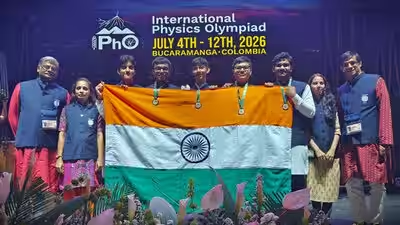
Ask an Indian teenager to name Virat Kohli, Neeraj Chopra or PV Sindhu and the answer comes instantly. But ask the same student about Kanishk Jain, Riddhesh Anant Bendale, Rishit Garg, Shresth Suraiya or Svarit Joshi, and you’re likely to be met with silence.However, these five students have achieved something that deserves to be celebrated across the country.Representing India at the 56th International Physics Olympiad (IPhO) 2026 in Bucaramanga, Colombia, all five returned home with gold medals, helping India finish joint world No. 1 alongside science powerhouses China, Russia, Kazakhstan, South Korea and Taiwan. It is only the second time that India has achieved a clean sweep of five gold medals in the prestigious competition.
“This is not another competitive exam”
Reacting to India’s remarkable performance, Product Lead and former JEE Physics teacher Malay Krishna explained why this achievement is so different from the exams most Indian students are familiar with.“I taught JEE Physics for years. That paper cracks strong kids in three hours,” he wrote to X.“But this exam is five hours of theory and five hours of lab work, and those five got almost perfect scores.”His post has resonated with thousands because it explains what makes the International Physics Olympiad one of the toughest academic competitions in the world.Unlike entrance exams that often test speed and familiarity with question patterns, the Olympiad demands original thinking. Students spend five hours solving advanced theoretical physics problems before moving on to another five-hour experimental exam where they are expected to design experiments, analyze data, estimate errors, and reach scientific conclusions with unfamiliar lab equipment.As Malay Krishna said, “Either you understand physics or you sit there for five hours.”
The five students who made history
This year’s Indian team consisted of:• Kanishk Jain from Pune • Riddhesh Anant Bendale of Indore • Rishit Garg from Dwarka, Delhi• Shresh Suraiya from Mumbai • Svarit Joshi from AhmedabadCompeting against 381 students from over 85 countries, each member of the Indian contingent won a gold medal.According to the Department of Atomic Energy (DAE), the achievement reflects the strength of India’s Olympic programme, which is coordinated by the Homi Bhabha Center for Science Education (HBCSE), a National Center of the Tata Institute of Fundamental Research (TIFR).The program identifies talented students through multiple stages of national-level examinations before putting them through rigorous training camps that ultimately produce the final five-member All India team.
Behind every medal are years of scientific thought
Malay Krishna also highlighted something that often goes unnoticed in discussions of oppositions.He noted that while coaching institutes have become exceptionally good at preparing students for familiar question patterns, Olympiad competitions demand an entirely different skill: thinking about problems students have never encountered before.“There is no shortcut chapter. There is no formula sheet to save you,” he wrote.This skill, he argued, has been quietly nurtured for decades through India’s publicly funded Olympics ecosystem.India’s consistency supports this claim. This was the country’s 27th appearance at the International Physics Olympiad. Over the past decade, every Indian participant has returned with a medal, with a majority winning gold.The success, however, also raises a larger question about fostering scientific talent. Malay Krishna noted that while a significant proportion of India’s Olympiad medalists go on to do doctoral research, many eventually build their careers abroad.“They have earned every option they have,” he wrote, while adding that India has become exceptionally good at identifying and training scientific talent. The next challenge, he suggested, is to create opportunities that encourage more to continue their work in the country.For now, however, the spotlight belongs to five young physicists who have quietly achieved something extraordinary.Their names may not yet be household names, but their success has placed India alongside the world’s best in one of the toughest science competitions on the planet. And maybe that’s reason enough for all students—and all parents—to remember them.Disclaimer: This article is based on publicly available information, official announcements and statements shared on LinkedIn by the person concerned. Quotations from his public publication have been reproduced for contextual purposes.