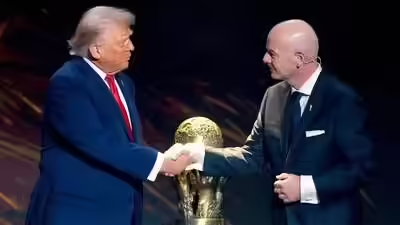
NEW DELHI: US President Donald Trump said he had personally asked FIFA president Gianni Infantino to review the red card and one-game suspension handed down to Team USA striker Folarin Balogun, a move that sparked a major controversy at the FIFA World Cup, according to CNN.FIFA later announced that Balogun would be eligible to play in the Round of 16 clash against Belgium after his suspension was lifted, a decision that sparked political debate and raised questions about the tournament’s integrity. “All I did was ask for a review. I didn’t say, ‘You have to do this,'” Trump said from the Oval Office, as quoted by CNN, adding that he “didn’t think it was a foul.” “I didn’t tell him what to do, I couldn’t tell him what to do,” he said, adding that an independent committee “made the right decision.”Balogun, the tournament’s top-scorer American with three goals, received a red card for awkwardly stepping on the right ankle of Bosnia-Herzegovina’s Tarik Muharemovic in a 2-0 round of 32 win on Wednesday, triggering an automatic one-match suspension.FIFA announced on Sunday that the suspension had been lifted for the round of 16 match, a rare move that drew praise from Trump and anger from the Belgium team. “Thank you to FIFA for doing what is right, and reversing a great injustice!” Trump later said in a statement on social media.The Royal Belgian Football Association (RBFA) said it was “surprised,” and Belgium coach Rudi Garcia scoffed at FIFA’s action.“I didn’t know that in the offices of FIFA the fifth of July was the first of April in Europe,” said Garcia through a translator in the April Fools’ Day comparison. “The Belgian federation is not defending itself, it is not defending the national team. He defends football in general, he defends his integrity, his behavior. I think this is the first time in the history of the World Cup that there has been this kind of decision.FIFA said its decision relied on Article 27 of the disciplinary committee’s rules.“The judicial body may decide to completely or partially suspend the implementation of a disciplinary measure,” the rule says. “By suspending the execution of the sentence, the judicial body subjects the person allowed to a trial period of one to four years.”